
You are about to sign off on an $80,000 tooling budget for an injection mold. Stop. If your annual production run is under 5,000 units, you are throwing capital into a black hole. In this guide, you will learn how comparing thermoforming vs injection molding is the fastest way to protect your margins, how vacuum forming tooling cost scales, and why custom plastic manufacturing does not always require high-pressure steel molds.
Key Takeaways:
- Tooling Cost Drop: Vacuum forming tools cost up to 80% less than injection molds.
- The Sweet Spot: Medium-volume runs (500 to 5,000 units annually) belong exclusively to thick-gauge thermoforming.
- Speed to Market: Aluminum thermoforming tools cut lead times from 16 weeks to under 5 weeks.
Why Are You Paying for 15,000 PSI?
Injection molding is a brute-force process. Melted polymer is forced into a cavity under massive pressure, often exceeding 15,000 PSI. To withstand this violent force, the tool must be a massive block of CNC-machined P20 or H13 steel. The Non-Recurring Engineering (NRE) costs are astronomical. You pay for two matched halves, complex ejector pins, cooling channels, and hydraulic slides. If you make 100,000 parts, that steel tool pays for itself. But if you only need 1,500 medical housings or heavy-duty machine covers, you will never amortize that tool. You are trapped in a financial hole before your first part ships.
Physics dictates the tooling cost. High clamp forces require heavy machinery and hardened metals. If you are designing parts with varying wall thicknesses, the material shrinkage will cause sink marks on injection-molded parts. To prevent this, engineers must comply with strict raw material standards, such as those governed by ASTM International polymer standards, which detail the mechanical and thermal properties of industrial plastics under stress. Vacuum forming bypasses these high-pressure mechanical realities entirely.
The Vacuum Forming Tooling Cost Advantage
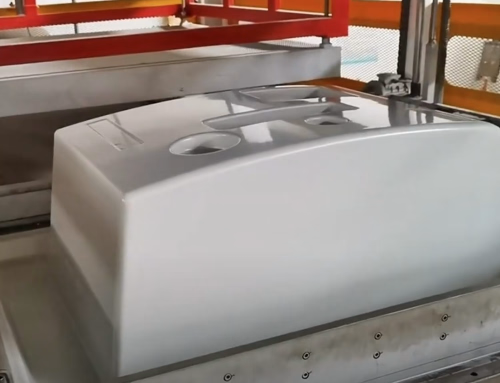
真空成形 relies on atmospheric pressure. We heat a flat sheet of plastic until it is pliable, drape it over a single-sided mold, and vacuum out the air. The pressure is only 14.7 PSI. Because the forces are low, we do not need tool steel. We CNC machine the mold from aircraft-grade 6061 aluminum.
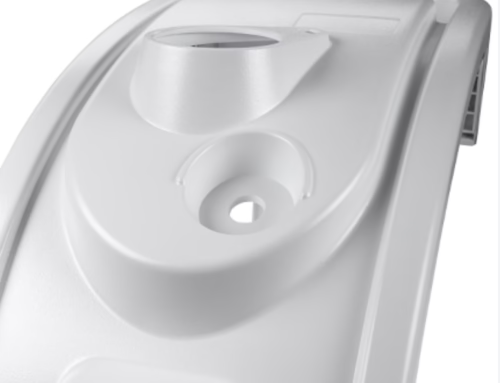
The math is simple. A single-sided aluminum tool requires half the machining time. There is no core-and-cavity matching. There are no complex ejector systems. The NRE tooling cost drops from $80,000 to $8,000. For medium-volume production, this is the undisputed financial sweet spot. You get parts that look identical to injection-molded components without the capital risk.
Large Plastic Parts: The Scale Problem
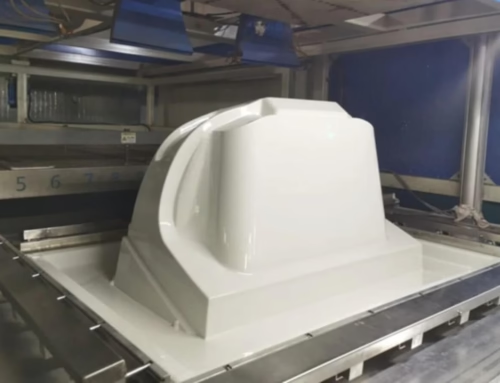
Size kills injection molding budgets. Want to mold a tractor bumper or an MRI machine cover? An injection press large enough to clamp a tool of that scale is the size of a two-story building. The tooling cost for a large-scale injection mold can easily cross $250,000.
Thick-gauge thermoforming handles massive footprints effortlessly. Our vacuum forming machines pull heavy-gauge sheets over large aluminum tools without requiring monstrous clamping forces. We routinely form sheets up to 10 feet long. The tool remains affordable because it is still just a single block of machined aluminum. If you are designing large plastic parts, thermoforming is often the only economically viable option.
よくあるご質問
Why is injection molding tooling so much more expensive than thermoforming?
Cavity pressure. Injection molding requires two halves of a hardened steel tool clamped together to withstand thousands of PSI of molten plastic. Thermoforming uses a single-sided aluminum tool under low vacuum pressure, slashing machining time and material costs.
What is the volume “sweet spot” for thick-gauge thermoforming?
Between 500 and 5,000 units annually. Below 100 units, use 3D printing or urethane casting. Above 20,000 units, injection molding amortizes the expensive steel tool. Thermoforming dominates the middle ground.
Can vacuum forming achieve the same tight dimensional tolerances as injection molding?
No. Injection molding controls both sides of the plastic geometry. Thermoforming only controls the side touching the tool (the A-side). However, we routinely hold ±0.030″ tolerances, which is more than strict enough for medical housings and radomes.
Do deep-draw vacuum-formed parts suffer from severe wall thinning?
If engineered poorly, yes. But Top Thermoforming prevents this by utilizing mechanical plug assists and zoned ceramic heaters to pre-stretch the plastic sheet, guaranteeing uniform wall thickness even on highly complex, deep geometries.
Is thermoforming limited to cheap, fragile plastics?
Absolutely not. We form heavy-duty, engineering-grade thermoplastics like Kydex, Polycarbonate, and flame-retardant ABS (UL94 V-0), specifically formulated for aerospace and medical compliance in US and European markets.
How much faster is the lead time for a thermoformed aluminum tool?
Cutting a temperature-controlled aluminum vacuum forming tool takes 1 to 2 weeks. Machining a multi-cavity steel injection mold takes 12 to 16 weeks. You get to market an entire fiscal quarter earlier.
Can I get undercuts and complex geometries with vacuum forming?
Yes, but it requires articulated tooling. We use pneumatic side-actions or collapsible cores within the aluminum mold to pull undercuts. It adds slight tooling cost, but remains a fraction of the price of an injection mold slide action.
Stop paying unnecessary NRE costs for medium-volume runs. Send your 3D CAD files to トップ熱成形 today for a free, no-nonsense tooling cost analysis.
 JA
JA  EN
EN  IT
IT  DE
DE  FR
FR  ES
ES  PL
PL  NL
NL